CHAIRMAN’S BLOG 2026.Q2 – 卓越營運需要全面整合:超越工具,實現統一變革Operational Excellence Demands Holistic Integration: Beyond Tools to a Unified Transformation
營運轉型、持續改進、組織文化變革與變革管理的交織之旅,達致持久成功
The Interwoven Journey of Operational Transformation, Continuous Improvement, Cultural Change, and Change Management for Lasting Success.
持久卓越的無形障礙 | The Unseen Barrier to Lasting Excellence
「卓越營運」(Operational Excellence, OpEx)計劃,無論其根源於精益(Lean)、六西格瑪(Six Sigma)還是限制理論(Theory of Constraints),都承諾帶來深遠的改進。組織投入巨資於價值流圖(Valus Steam Mapping)、5S、標準作業及 DMAIC(定義、測量、分析、改進、控制)等方法。然而,常見而令人沮喪的模式卻屢屢出現:試點項目取得了顯著成果,但在更廣泛推廣後,這些成果便停滯不前,甚至退步。這不僅僅是工具的失敗或意圖的不足,通常源於一個錯誤的信念,導致系統性的崩潰,即營運轉型、持續改進、組織文化變革和變革管理是獨立的項目或舉措,而非一個整體轉型旅程中深度交織的組成部分。當這些元素被分割時,即使是最傑出的流程再設計也無法轉化為持續的績效或根深蒂固的新工作方式。
“Operational Excellence” (OpEx) initiatives, whether rooted in Lean, Six Sigma, or Theory of Constraints, promise profound improvements. Organizations invest heavily in sophisticated methodologies like value stream mapping, 5S, standard work, and DMAIC. Yet, a common, disheartening pattern emerges: pilot projects deliver dramatic gains, only for results to plateau or degrade during wider rollout. This isn’t merely a failure of tools or a lack of good intentions; it’s a systemic breakdown, often stemming from the mistaken belief that operational transformation, continuous improvement, organizational cultural change, and change management are separate projects or initiatives, rather than deeply intertwined components of a holistic transformation journey. When these elements are treated in isolation, even the most brilliant process redesigns fail to translate into sustained performance or embedded new ways of working.
全方位整合的關鍵 | Holistic Approach: The Power of Integration
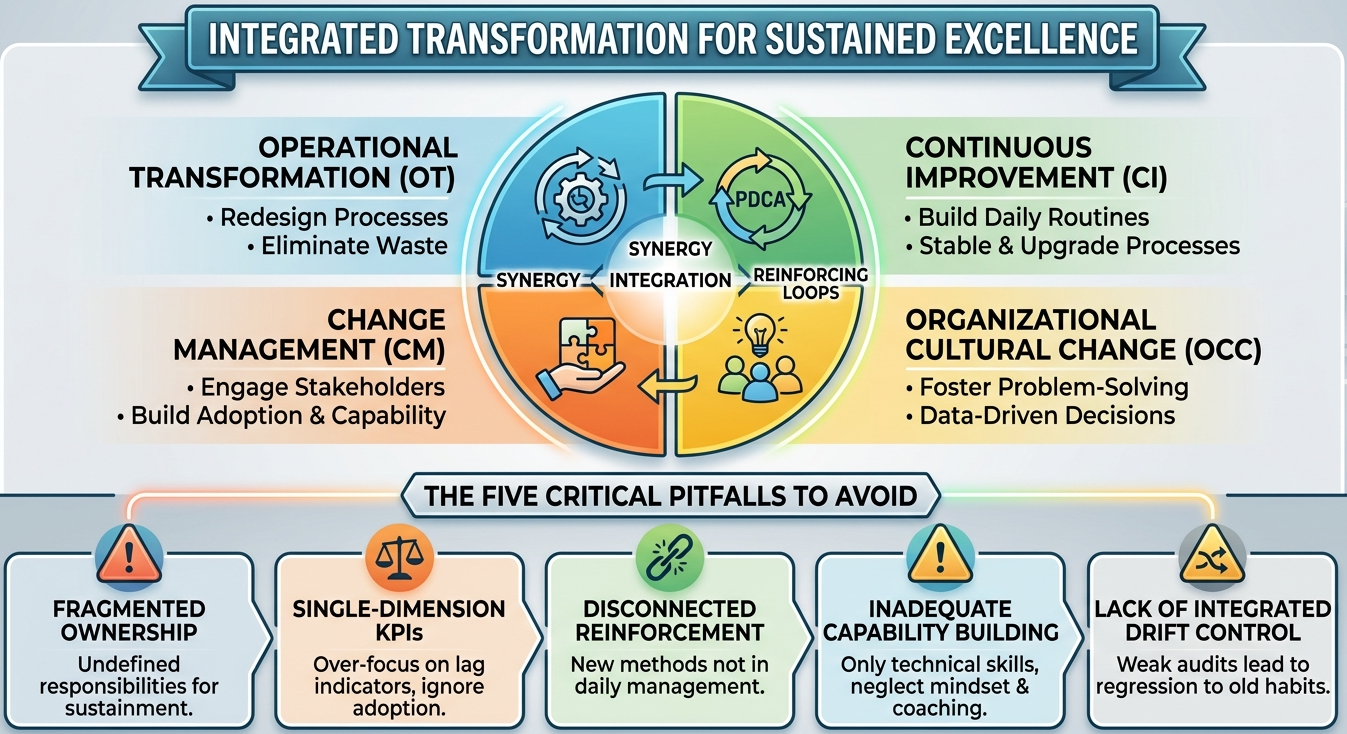
精益六西格瑪為營運轉型提供了強大的「做什麼」(What) 和「如何做」(How) —重新設計流程以消除浪費、減少變異並最大化流程。這是創造績效「一步到位」的初步「大爆炸」。但要使這些改變生根發芽並蓬勃發展,它們必須得到人員的接納和持續。這正是協同作用變得至關重要之處。持續改進(CI)確保初步成果不會曇花一現,建立日常常規(改善(Kaizen)活動、PDCA循環)以穩定新流程、解決突發性問題,並超越最初原型,持續改進績效。營運轉型(Operational Transformation, OT)建立新道路;持續改進(CI)確保其持續維護和逐步升級。
Lean Six Sigma provides the powerful “what” and “how” for operational transformation—redesigning processes to eliminate waste, reduce variation, and maximize flow. This is the initial “big bang” that creates a step-change in performance. But for these changes to take root and flourish, they must be embraced and sustained by people. This is where the synergy becomes critical. Continuous improvement (CI) ensures the initial gains aren’t fleeting, establishing daily routines (Kaizen events, PDCA cycles) to stabilize new processes, resolve emergent issues, and continually refine performance beyond the initial transformation. Operational Transformation builds the new highway; CI ensures its continuous maintenance and incremental upgrade.
營運上的進步不僅是技術上的成就;它們是推動組織文化變革(Organizational Cultural Change, OCC)的強大動力。文化變革不是簡單地宣佈即可,它透過共同經驗和新的工作方式來演變。當人們參與價值流圖、根本原因分析(DMAIC)或識別瓶頸(限制理論)時,他們被迫協作、運用數據、挑戰假設並承擔責任。這種「實踐」是組織文化變革(OCC)最有效的驅動力,自然而然地培養出解決問題、消除浪費和數據驅動決策的文化。反之,開放、信任和樂於學習的基礎文化對於營運轉型(OT)和持續改進(Continous Improvement, CI)的生根發芽和茁壯成長也同樣至關重要。如果文化抗拒變革、保護壁壘或害怕失敗,即使是最精妙設計的營運轉型也會失敗。這是一個良性循環:卓越營運(OpEx)舉措塑造文化,而支持性文化則進一步推動卓越營運的成功。
These operational advancements are not just technical feats; they are potent vehicles for organizational cultural change (OCC). You cannot simply declare a culture change; it evolves through shared experiences and new ways of working. As people engage in value stream mapping, root cause analysis (DMAIC), or identifying bottlenecks (TOC), they are compelled to collaborate, use data, challenge assumptions, and take ownership. This “doing” is the most potent driver of OCC, naturally cultivating a culture of problem-solvers, waste-eliminators, and data-driven decision-makers. Conversely, a foundational culture of openness, trust, and a willingness to learn is equally vital for OT/CI to take root and thrive. If the culture is resistant, siloed, or fearful of failure, even the most brilliantly designed operational transformation will falter. This is a virtuous cycle: OpEx initiatives shape culture, and a supportive culture fuels further OpEx success.
最後,變革管理(Change Management, CM)充當協調者和整合者。它是將所有這些元素結合在一起的黏合劑,確保人員旅程得到有效管理。對於營運轉型(OT),變革管理(CM)確保策略願景清晰傳達、受影響的持份者參與其中,並獲得關鍵的贊助支持,從而減輕對根本性變革的阻力。對於持續改進(CI),變革管理(CM)建立員工積極參與日常改進的能力和信心,提供培訓、輔導和對其貢獻的認可。對於組織文化變革(OCC),變革管理(CM)明確解決文化轉變中固有的阻力點,促進對話、管理期望,並提供新行為內化所需的心理支持。當領導層將卓越營運視為一個統一的變革生態系統,並透過整合策略而非孤立培訓來期望行為轉變時,實施便能從脆弱走向堅實。成功取決於一個深思熟慮的「採納系統」,它全面解決了我們如何從根本上重新設計營運、持續改進它們、培養適應性文化,並有效管理每一步的人力變革。
Finally, change management (CM) acts as the orchestrator and integrator. It’s the glue that binds all these elements together and ensures the human journey is managed effectively. For OT, CM ensures the strategic vision is clearly communicated, stakeholders engaged, and sponsorship secured, mitigating resistance to radical changes. For CI, CM builds the capabilities and confidence for employees to actively participate in daily improvement, providing training, coaching, and recognition. For OCC, CM explicitly addresses resistance points, facilitating dialogues, managing expectations, and providing the psychological support necessary for new behaviors to become ingrained. When leadership approaches OpEx as a single, unified ecosystem of change, expecting behavior shifts through integrated strategies rather than isolated training, implementation transitions from fragile to foundational. Success hinges on a deliberate “adoption system” that holistically addresses how we fundamentally redesign operations, continuously improve them, foster an adaptive culture, and effectively manage every human step along the way.
五個常見陷阱/鴻溝 | The Five Common Gaps in a Fragmented Approach
- 碎片化的所有權:營運變革由項目團隊負責,但維持這些變革(CI)、嵌入新的文化規範(OCC)以及管理人員轉型(CM)的所有權卻不清晰。這導致倡導者筋疲力盡,新流程缺乏長期管理。
- 單一維度關鍵績效指標: 我們雖然細緻地追蹤營運指標(缺陷率、週期時間),卻忽視了文化轉變和人員採納的關鍵指標(例如,培訓有效性導致觀察到的能力、對新標準作業的遵循度、員工參與改進計劃的程度)。缺乏整體測量系統,整合的成功便會隱而不見。
- 斷開的強化循環: 新的營運方法未能無縫地融入日常管理系統(CI),因而未能成為組織文化的一部分。它們仍然是「附加」活動,而非嵌入式的工作方式,缺乏持續的強化和反饋。
- 不足的整體能力建設: 培訓狹隘地專注於新流程的技術層面(OT/CI),假設人們會自然適應。它往往忽視了文化轉變所需的更廣泛技能(例如,解決問題的心態)以及嵌入新行為所需的持續輔導(CM)。
- 缺乏對漂移的整合控制: 儘管標準作業(OT)已經設計完成,但持續驗證(CI)、文化強化和系統性審核(CM)的機制卻很薄弱。流程回歸舊習,這不僅僅是技術問題,更是因為人力和文化系統未能內化新的工作方式。
When OT, CI, OCC, and CM are not deeply integrated, organizations fall into predictable traps:
- Fragmented Ownership: Operational changes are owned by project teams, but the ownership for sustaining those changes (CI), embedding new cultural norms (OCC), and managing the human transition (CM) remains unclear. This leads to champions burning out and new processes lacking long-term stewardship.
- Unidimensional KPIs: We meticulously track operational metrics (defect rates, cycle time) but neglect crucial indicators for cultural shift and human adoption (e.g., training effectiveness leading to observed competence, adherence to new standard work, employee engagement with improvement initiatives). Without a holistic measurement system, the integrated success remains invisible.
- Disconnected Reinforcement Loops: New operational methods aren’t seamlessly woven into daily management systems (CI), failing to become part of the organizational culture. They remain “add-ons” rather than embedded ways of working, lacking consistent reinforcement and feedback.
- Insufficient Holistic Capability Building: Training focuses narrowly on the technical aspects of the new process (OT/CI), assuming that people will naturally adapt. It often overlooks the broader skills required for cultural shift (e.g., problem-solving mindsets) and the sustained coaching (CM) needed to embed new behaviors.
- Lack of Integrated Control for Drift: While standard work (OT) is designed, the mechanisms for continuous verification (CI), cultural reinforcement, and systematic auditing (CM) are weak. Processes drift back, not just due to technical issues, but because the human and cultural systems didn’t internalize the new way.
將 DMAIC 應用為整體轉型框架 | Leveraging DMAIC as a Holistic Transformation Framework
作為精益六西格瑪核心的 DMAIC 框架,為整合營運轉型(OT)、持續改進(CI)、組織文化變革(OCC)和變革管理(CM)提供了強大的結構。它提供了一個系統化的視角來管理技術性的「改進」和人性/系統性的「實施」:
- 定義(Define):
- 整合目標: 不僅闡明期望的營運成果(例如,將前置時間減少30%),還要明確的變革目標(例如,「90%的操作員在30天內持續遵循更新後的標準作業」,「100%的班長能教授流程步驟和升級觸發點」),以及所需的文化轉變(例如,培養積極主動解決問題的文化)。變革管理確保所有持份者對此整體願景達成共識。
- 測量(Measure):
- 整體基線: 捕捉基線(Baseline)營運績效,以及當前的採納指標(遵循率、掌握新技能所需時間、觀察到的偏差)和文化指標(例如,對反饋的開放程度、跨職能協作水平)。此階段在變革管理的指導下,還會識別系統性風險和潛在的阻力點。
- 分析(Analyze):
- 營運與人為差距的根本原因: 不僅診斷當前流程表現不佳的原因(OpEx視角),還要診斷人們可能抵制新方式的原因(變革管理視角)。根本原因往往是行為、文化和系統性的:激勵錯配、決策權不明確(阻礙組織文化變革)、工作量過大或工具摩擦。
- 改進(Improve):
- 整合設計: 此階段涉及設計技術性的修正(使用精益六西格瑪工具)以及全面的人員採納和文化嵌入實施套件。此套件包括更新的標準作業程序(SOP)、輔助工具、基於角色的培訓(建立持續改進能力)、輔導計劃(變革管理)以及「如何及何時升級」的指示—所有這些都旨在與期望的文化轉變保持一致。
- 控制(Control):
- 持續轉型: 制定穩健的控制計劃,不僅針對技術流程,更關鍵的是為了嵌入期望的行為和文化規範。這意味著透過審核(OpEx/CI)、視覺管理(CI)、日常檢視(CI/CM)、升級門檻和持續輔導觸發點(CM)進行持續監控。此階段是新營運方法真正根植於組織文化之中。
The DMAIC framework, central to Lean Six Sigma, offers a powerful structure for integrating OT, CI, OCC, and CM. It provides a systematic lens to manage both the technical “improve” and the human/systemic “implement”:
- Define:
- Integrated Target: Articulate not just the desired operational outcomes (e.g., reduce lead time by 30%), but also the explicit change objectives (e.g., “90% of operators follow updated standard work within 30 days,” “100% of shift leads can teach the process steps and escalation triggers”) and the cultural shifts required (e.g., fostering a culture of proactive problem-solving). CM ensures alignment across stakeholders on this holistic vision.
- Measure:
- Holistic Baselines: Capture baseline operational performance, alongside current adoption metrics (compliance rates, time-to-proficiency, observed deviations) and cultural indicators (e.g., openness to feedback, cross-functional collaboration levels). This phase, guided by CM, also identifies systemic risks and potential resistance points.
- Analyze:
- Root Causes of Operational & Human Gaps: Diagnose not only why the current process underperforms (OpEx lens) but also why people might resist the new way (CM lens). Root causes are often behavioral, cultural, and systemic: misaligned incentives, unclear decision rights (impeding OCC), workload, or tool friction.
- Improve:
- Integrated Design: This phase involves designing both the technical operational fix (using Lean Six Sigma tools) and the comprehensive implementation package for human adoption and cultural embedment. This package includes updated SOPs, job aids, role-based training (building CI capability), coaching plans (CM), and “how to escalate” instructions—all designed to align with the desired cultural shifts.
- Control:
- Sustained Transformation: Develop robust control plans for both the technical process and for embedding the desired behaviors and cultural norms. This means continuous monitoring through audits (OpEx/CI), visual management (CI), daily check-ins (CI/CM), escalation thresholds, and ongoing coaching triggers (CM). This phase is where the new operational methods become truly ingrained within the organizational culture.
實現持久卓越的鎖定機制 | Lock-in Mechanisms for Enduring Excellence
要使卓越營運真正成為組織DNA中例行且根深蒂固的一部分,營運轉型(OT)、持續改進(CI)、組織文化變革(OCC)和變革管理(CM)的協同作用必須被積極鎖定:
- 整合的標準作業與能力建立: 除了單純的標準作業文件,確保作業輔助工具直觀易懂,並至關重要的是,進行技能驗證(不僅是參與培訓),配合持續輔導(CM)以建立和維持能力(CI)。這強化了紀律執行的文化。
- 全面的日常管理整合: 新流程、其績效以及任何偏差必須是日常會報和檢查表(CI)的核心內容。這種持續的可見性,由前線領導者積極管理,強化了新行為和解決問題的心態,體現了期望的組織文化。
- 發展性流程遵循審核: 實施頻繁、簡短且非懲罰性的審核。這些審核不僅用於流程遵循(OT/CI),更用於識別培訓、理解或系統支持方面的差距,從而實現有針對性的輔導並強化持續學習的文化(CM/OCC)。
- 整合成功的領先指標: 不僅追蹤營運績效,還要追蹤採納和文化嵌入的領先指標(例如,審核分數、首次正確率、參與改善活動的程度)。這些在滯後的財務結果出現之前,就提供了整體轉型健康狀況的早期信號。
- 響應式升級與限制解決: 建立清晰的機制,用於升級問題—無論是營運限制(限制理論)、能力差距還是阻礙採納的系統性障礙。領導層對這些問題的迅速回應(CM)能增強信任和承諾,強化支持持續改進的組織文化。“`
For operational excellence to become truly routine and embedded within the organization’s DNA, the synergy of OT, CI, OCC, and CM must be actively locked in:
- Integrated Standard Work & Capability Building: Beyond mere standard work documents, ensure job aids are intuitive, and crucially, conduct skill validation (not just attendance) with ongoing coaching (CM) to build and sustain competence (CI). This reinforces a culture of disciplined execution.
- Holistic Daily Management Integration: The new processes, their performance, and any deviations must be central to daily huddles and check sheets (CI). This constant visibility, actively managed by frontline leaders, reinforces new behaviors and problem-solving mindsets, embodying the desired organizational culture.
- Developmental Process Compliance Audits: Implement frequent, short, and non-punitive audits. These aren’t just for process adherence (OT/CI) but for identifying gaps in training, understanding, or systemic support, enabling targeted coaching and reinforcing a culture of continuous learning (CM/OCC).
- Leading Indicators of Integrated Success: Track not just operational performance, but leading indicators of adoption and cultural embedment (e.g., audit scores, first-time-right metrics, engagement with Kaizen activities). These provide early signals of the holistic transformation’s health, long before lagging financial results.
- Responsive Escalation & Constraint Resolution: Establish clear mechanisms for escalating issues—be they operational constraints (TOC), capability gaps, or systemic barriers to adoption. Leadership’s swift response (CM) to resolve these reinforces trust and commitment, strengthening the organizational culture that supports continuous improvement.
Collaboration: The Foundation of Sustainable Success
Lean Six Sigma and OpEx methodologies generate the clarity and data needed for superior operational design. Change management ensures that the organization not only understands this clarity but also absorbs, adopts, and consistently utilizes it. The operational excellence team must champion the technical transformation, while change leaders orchestrate the human journey, and both must continually nurture the organizational culture. This requires treating adoption and cultural evolution as integrated, measurable deliverables, where process metrics serve as tangible proof of holistic progress, far beyond mere survey feedback. By intentionally weaving together Operational Transformation, Continuous Improvement, Organizational Cultural Change, and Change Management, organizations forge a powerful, resilient ecosystem that delivers not just temporary gains, but enduring, sustainable excellence.
