

ESG with Six Sigma: Chapter 2 – Starting from Environmental “E” 第二章 – 從環境、社會與公司治理中的環境開始
Environmental concerns have evolved from early public outcry to a core pillar of global corporate governance. Modern environmental awareness emerged in the 1960s‑1970s, spurred by high‑profile pollution disasters and the 1972 Stockholm Conference on the Human Environment. The 1987 Brundtland Report formalised the concept of sustainable development, while the 1992 Rio Earth Summit set the foundations for global environmental cooperation.
Today, environmental risks are increasingly urgent. Climate change, carbon emissions, waste accumulation, biodiversity loss and water scarcity pose material business risks. Extreme weather disrupts supply chains, increases operational costs and damages corporate reputations. Many organisations still treat environmental management as compliance‑only work, lacking systematic measurement and continuous improvement.
Environmental management has progressed from basic pollution‑control compliance to carbon accounting, circular economy and net‑zero target setting. Early‑stage practices focused on end‑of‑pipe pollution treatment. Later phases introduced environmental management systems (such as ISO 14001), carbon footprint calculation, waste reduction and circular‑economy initiatives. In recent years, stakeholders demand quantifiable, auditable environmental performance rather than vague green claims.
Regulatory landscapes differ across jurisdictions. In the European Union, CSRD, EU Taxonomy and SFDR mandate detailed environmental disclosure and sustainability verification. The CSRD first applies to companies for the 2024 financial year (reports published in 2025). Recent 2025-2026 developments include the “Omnibus Simplification Package” (February 2025) raising thresholds and a “Stop-the-Clock” Directive (April 2025) temporarily pausing certain obligations. In the United States, SEC climate‑related disclosure rules push listed firms to report climate risks. In March 2025, the SEC voted to end its defence of the rules, and as of September 2025, the Eighth Circuit holds petitions in abeyance pending reconsideration. This is a critical update—these rules are currently in limbo. Mainland China enforces dual‑carbon goals, environmental protection laws and mandatory reporting for high‑polluting industries. A-share listed companies have been required to disclose annual ESG reports since 2022. On July 1, 2025, new CSRC measures formally mandated ESG disclosure in annual reports for all listed companies, with third-party assurance encouraged.
In Hong Kong, the Stock Exchange of Hong Kong (HKEX) ESG Listing Rules require listed companies to disclose environmental metrics. High‑impact sectors include power, construction, logistics, manufacturing and retail. Large-cap issuers face mandatory transition plan disclosure from January 1, 2026. The HKICPA published HKFRS S1 and S2 (fully ISSB-aligned) in December 2024, effective August 1, 2025 for voluntary use, with a roadmap to extend to all publicly accountable entities by 2028. Hong Kong’s 2024 GHG emissions were 33.2 million tonnes of CO2-e, down 3.6% from 2023 and 27% from the 2014 peak. Per capita emissions reached 4.41 tonnes in 2024.
Looking beyond 2026, global targets centre on limiting global warming, net‑zero transition and biodiversity recovery. More jurisdictions will enforce mandatory environmental disclosures, while greenwashing scrutiny will tighten. Companies will be expected to embed environmental metrics into core business planning, aligning with ISSB IFRS S1/S2 standards.
In Hong Kong, multiple bodies provide environmental measurement tools. The Environmental Protection Department (EPD) offers carbon‑calculation guidance and emission inventories. The Hong Kong Quality Assurance Agency (HKQAA) promotes ISO 14001 certification. Industry associations and professional institutes publish carbon‑footprint calculators, waste‑assessment frameworks and benchmarking tools for enterprises.
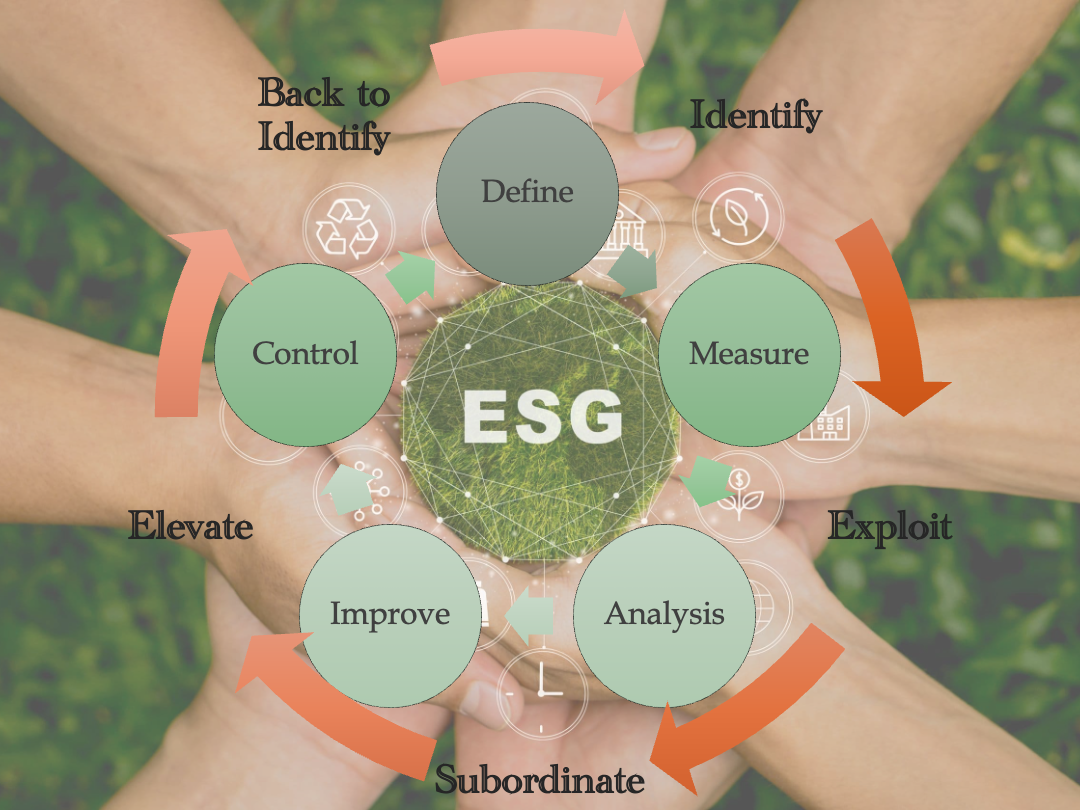
Other local environmental developments in Hong Kong include the city’s carbon‑neutrality target by 2050, municipal waste‑charging schemes, plastic‑reduction policies and green building standards. Many small‑and‑medium‑sized enterprises still face barriers: limited resources, lack of in‑house expertise and difficulty translating environmental data into actionable improvement plans. This is where Six‑Sigma DMAIC can deliver value: applying Define‑Measure‑Analyse‑Improve‑Control to identify environmental gaps, quantify impacts and drive sustained environmental performance improvement.
Six Sigma Institute offers a wide range of ESG and Six Sigma-related seminars and courses. Please visit our website for more information.
**第二章 – 從環境、社會與公司治理中的環境開始
環境議題已經由早期社會大眾的抗議聲浪,演變成為全球企業管治的核心支柱。現代環境意識興起於1960至1970年代,受到多起重大污染事故以及1972年斯德哥爾摩人類環境會議所推動。1987年《布倫特蘭報告》正式確立永續發展概念,1992年里約地球高峰會則奠定全球環境合作的基礎。
現今環境風險日趨嚴峻,氣候變化、溫室氣體排放、廢棄物累積、生物多樣性流失與水資源短缺均構成企業實質風險。極端天氣會擾亂供應鏈、推高營運成本並損害企業聲譽。不少機構仍將環境管理視為單純合規工作,欠缺系統化量度與持續改善機制。
環境管理的發展歷程,由早期末端污染治理,逐步演進至碳會計、循環經濟與淨零目標制訂。初期做法著重污染排放處理;後續階段引入ISO 14001環境管理體系、碳足跡核算、減廢及循環經濟措施。近年來,持份者要求可量化、可稽核的環境績效,而非空泛的綠色宣稱。
各地監管規則各有不同。歐盟透過CSRD、歐盟永續分類法及SFDR,強制要求詳細環境資訊披露與永續表現驗證;美國證券交易委員會(SEC)氣候披露規則,要求上市公司申報氣候相關風險;中國內地推行雙碳目標、環保法規,高污染行業須強制申報環境數據。香港方面,香港交易所(HKEX)ESG上市規則要求上市公司披露環境指標。受影響較大的行業包括電力、建築、物流、製造及零售業。
展望2026年之後,全球目標圍繞氣溫控制、淨零轉型及生物多樣性復原。更多地區會落實強制環境披露,同時加強打擊漂綠行為。企業需要將環境指標納入核心業務規劃,並遵從國際永續準則理事會(ISSB)的IFRS S1/S2標準。
香港有多個機構提供環境量度工具:環境保護署(EPD)提供碳計算指引與排放清單;香港品質保證局(HKQAA)推廣ISO 14001認證;各行業協會及專業學會亦開發碳足跡計算工具、廢物評估框架以及企業基準比較工具。
香港其他環境發展包括2050年碳中和目標、都市固體廢物收費、減塑政策以及綠色建築標準。大量中小企業仍然面對障礙:資源有限、內部專業人才不足,難以把環境數據轉化為可執行的改善方案。這正是六式碼DMAIC可以發揮作用的地方:透過界定、衡量、分析、改善、控制的邏輯,辨識環境缺口、量化環境影響,推動環境績效持續優化。
如欲了解更多 ESG 與Six Sigma應用,六式碼學院提供多元相關講座及課程,歡迎瀏覽本院網站以獲取更多資料。